What is Bumble Bee Watch?
Bumble Bee Watch is a collaborative effort to track and conserve North America’s bumble bees. This citizen science project allows for individuals to:
- Upload photos of bumble bees to start a virtual bumble bee collection;
- Identify the bumble bees in your photos and have your identifications verified by experts;
- Help researchers determine the status and conservation needs of bumble bees;
- Help locate rare or endangered populations of bumble bees;
- Learn about bumble bees, their ecology, and ongoing conservation efforts; and
- Connect with other citizen scientists.
How can you participate?
We need your help! Because these animals are widely distributed the best way to keep track of them is with an army of volunteers across the country armed with cameras. With any luck, you might help us to find remnant populations of rare species before they go extinct. Participating in Bumble Bee Watch is simple and you can get started now by creating an account via the “sign in” tab at the top of the page. Once you have an account, go out and check your garden, in parks, or any other natural areas you frequent for bumble bees. Be sure to snap a photo (learn more about how to photograph bees here) and then sign in and submit your data via our Bumble Bee Sightings form. Have fun while learning more about bumble bees and the vital role they play in our environment!
Other ways you can help:
- Create habitat! You can find more information about how to create bumble bee habitat at www.xerces.org/bumblebees.
- Support local and organic agriculture. Many pesticides are harmful to bumblebee colonies and many vegetable and fruit plants provide great food sources for bees.
- Spread the word! Many people are afraid of bumble bees and other insects. Let your friends and family know how important they are and encourage them to take photos too!
Bumble bees are quite docile and will only sting when their nest is threatened or if they are cornered. Observing a bumble bee at a flower and taking pictures is generally a safe activity. Just be sure not to try to touch the bee or get too close. Be careful near nests and take photos from several feet (>1m) away if you come across one in your travels.
Bumble Bee Anatomy
All insects have three main body parts: the head, thorax and abdomen. Our online key focuses on color patterns on each of these three body parts. Photos that include the color patterns on all three of these body parts will be the most helpful. Many species profile pages refer to color patterns on T1-5. T refers to abdominal segments on the “back” of the bee. T actually refers to the term Tergal. So T-1 is tergal segment 1; see diagram below.
Basic bumble bee anatomy:

- Click for a larger image.

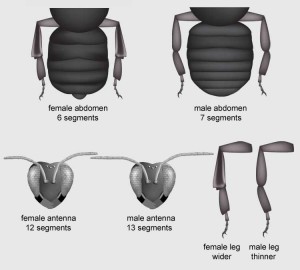
In order to properly identify bumble bees, you need to first determine whether the bee you are examining is male or female. There are three different types of bumble bees you will encounter: workers, queens, and males. Both queens and workers are female. In most cases, queens and workers have similar coloration and physical features, except that queens tend to be much larger. Males can differ in coloration from females of the same species, as well as other physical characteristics. Because male bumble bees have a lot of variation and are difficult to identify from photographs, our survey is currently only focusing on females.
Is your bumble bee male or female?
Tips for Photographing Bees
What makes a good bumble bee photo?
There are many strategies for snapping photos of fast moving insects, but sometimes a helpful tip can be to wait at an open flower of a species attractive to bumble bees instead of trying to follow a bee around. This is especially true if you are using a smartphone, or point and shoot camera that is slow to respond after the shutter button is pressed.
While some species can be identified from almost any photograph, there are some characters that are helpful to try and include in your photographs. In general, it is helpful to include multiple photos from different angles to give the best chance of a positive ID.
Below we provide specific recommendations, but please also check out our bumble bee anatomy page.
Here are some helpful tips:
Don’t be afraid to get close to bumble bees when they are visiting flowers. As long as you don’t touch them, you are very unlikely to get stung. Close-ups are the best photos as they allow the observer to see more detail!
If your camera has one, use the macro setting (usually an icon of a flower)! This usually lets you focus on objects closer to the camera.
Include photos from a few different angles. These will help you to see all of the characters on the bee.
Try to include a shot that includes the face of the bumble bee. The coloration of the face can be important, but the structure of the face is often an essential character to verify submitted records.
Cropping your photos before uploading them can also be an effective way to illuminate more detail.
Putting a bee in a vial (they can often be captured directly into the vial from a flower) can be an effective way to snap some clear photos.

If you are using a smart phone, another option is to take a video of the bumble bee and then extract images from the video file. There are numerous ways to do this, and a quick web search should lead you in the right direction.
Don’t worry if you can’t ID the bee in your photo! Bumble bees can be tricky. Your photo submission will still help us keep track of bumble bee populations and it is quite possible that our experts may be able to ID your bumble bee. We carefully verify all of our photo submissions.
More Resources
Bumble bees
Bumble bee ID help
- Western US
- Eastern US
- North America: Coming Soon!
Information about other native bees
Conservation guidance and plant lists
Regional bumble bee efforts
- Illinois: Bee Spotter
- Nebraska: Bumbleboosters
- Texas: Texas Bumble Bees
- Vermont: Vermont Bumble Bee Survey
- Wyoming: Bumble Bee Brigade
 ramblingwoods.com