Nature Notes (#460)~Do You See Faces In The Clouds? The Science of Pareidolia

nature notes logo

Join Nature Notes from Mondays at 11:00 pm EST  to Friday at 11:00 pm EST.

More information can be found at the top of the blog on a separate page, but it really is easy. What are you or have you seen and enjoyed in nature? It can be from your own backyard, the local park, out on a hike, or anywhere. What plants and animals catch your interest? Do you garden? Have you read a good book on nature? 

Write a blog post with a photo, a story, a poem, anything goes because I love to see what Mother Nature is up to in your area. Please submit one blog post per week and link it back to Nature Notes in some way.

Below is last week’s Nature Notes’ blogger thumbnail photos in a collage. If your photos are protected and/or you don’t want me to use them, please let me know. Also listed are all the links to last week’s Nature Notes blog posts if you missed any.

What are you seeing in nature? It can be from your own backyard, the local park, out on a hike or anywhere. What plants and animals catch your interest? What do you find interesting in nature? Take a photo, write a post, a story, a poem, anything goes because I love to see what Mother Nature is up to in your area. PS..please check back and visit bloggers who post later in the week!


— It was record breaking cold then to record breaking hot and now to lots of rain. May has been an interesting weather month.

Do You See Faces In The Clouds? The Science of Pareidolia

From The Farmer’s Almanac-

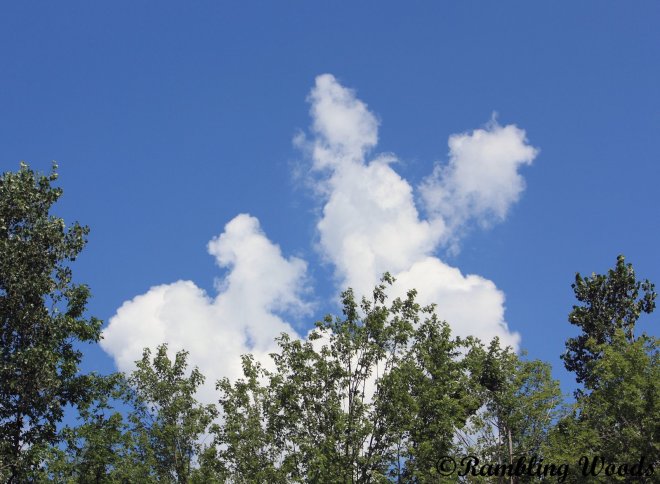
Have you ever seen an angel, a castle, a dog, or a face in the clouds? Or maybe a grilled cheese sandwich that looked suspiciously similar to a celebrity? We’ve all seen everyday things that look like something or someone else. The good news is that it doesn’t mean we’re a little crazy or overly imaginative. Instead, the ability to look at random objects and see familiar things is a perfectly normal phenomenon called pareidoliaa word from the Greek meaning, “resembling an image.

I have long loved looking at the clouds and seeing what I could “see” suggested in them. But I didn’t know it had a name.

The Science of Pareidolia

For many years, scientists had a variety of explanations for this phenomenon. Some thought that seeing faces in the clouds was a symptom of psychosis while others, including famous scientist Carl Sagan, thought that pareidolia came from an evolutionary need to recognize people or potential threats quickly.

In actuality, pareidolia comes from our need to organize random information into patterns. That’s why, when glancing at something simple like an electrical outlet, most people would agree that it looks like a face.

This search for patterns isn’t limited to sight, either. While it’s much more common to see a face or object in a random place, people can hear pareidolia, too. If you’ve ever listened to static or the roar of your vacuum cleaner and thought you heard someone speaking, you’ve experienced auditory pareidolia.


Where to See Pareidolia

Pareidolia pops up everywhere – in clouds, tree bark, among clustered leaves, on a piece of toast, in a bowl of cereal, or anywhere else. The best places to look include spots with random patterns, like the grain of plywood or the shapes made by a rock formation.

It’s such a common phenomenon that there are many well-documented instances of pareidolia. When you look at the Moon, you can see several famous pareidolic images, including the Man in the Moon. The Moon’s smiling face is actually patches of light and dark terrain. Among those spots of light and dark, people have seen a variety of different things, including a man with a rifle and dog, a rabbit and a woman. There are even some fascinating images of faces on Mars.

Pluto on Pluto?

In fact, the images of Pluto from NASA’s New Horizons spacecraft is another example of pareidolia. Some say they see a heart, others say they see the cartoon character, Pluto! What do you see?
Have a wonderful week from Michelle


Nature Notes (#457)~For when I look at the Moon I do not see a hostile, empty world. I see the radiant body where man has taken his first steps into a frontier that will never end.~ David R. Scott, Commander Apollo 15,

nature notes logo

Join Nature Notes from Mondays at 11:00 pm EST  to Friday at 11:00 pm EST.

More information can be found at the top of the blog on a separate page, but it really is easy. What are you or have you seen and enjoyed in nature? It can be from your own backyard, the local park, out on a hike or anywhere. What plants and animals catch your interest? Do you garden? Have you read a good book on nature? 

Write a blog post with a photo, a story, a poem, anything goes because I love to see what Mother Nature is up to in your area. Please submit one blog post per week and link back to Nature Notes in some way.

Below is last week’s Nature Notes’ blogger thumbnail photos in a collage. If you photos are protected and/or you don’t want me to use them, please let know. Also listed are all the links to last week’s Nature Notes blog posts if you missed any.


I am writing this on the weekend and watching the snow fall. Record-setting cold and snow through Monday. I see geese with goslings and some of the trees are blooming and I don’t know what will happen. The warm days I saw bees out, but don’t know that they can survive the cold.

There was the last supermoon of 2020 called The Flower Moon. I knew bad weather was moving in so I took photos a couple of days before the full moon. This was taken with a small camera so it isn’t the best but as I looked at it, I realized that I don’t remember much about the moon. But NASA does…

“The Moon is one celestial object that never fails to impress when seen in a telescope. It’s our nearest neighbor in space — big, bright, beautifully bleak, and just a quarter million miles away. That’s fewer miles than you may have ridden in cars, and 100 times closer than our next nearest major astronomical neighbor (Venus) ever gets. This makes the Moon a wonderful target for even the most humble astronomical instrument. You can spot and name at least a dozen of its surface features with the unaided eye. Binoculars show scores more, and a telescope can keep you busy on the Moon forever. Of course, just looking and not knowing what you’re seeing will grow old pretty fast. As in all of astronomy, the rewards come from recognizing and understanding what you find, and from planning neat things to seek out. Let’s get started with some moon facts.”

Moon Facts: The Moon’s Changing Phase

“Each month as the Moon circles the Earth, we see it go through its cycle of phases, one of the obvious moon facts. Starting from “new Moon,” when it is nearly in our line of sight to the Sun, the Moon grows, or waxes, to a crescent, then to first quarter (half lit), gibbous (somewhat football-shaped), and full. Then the Moon wanes back through gibbous, last-quarter, and crescent phases to new again.”

SEAS OF LAVA

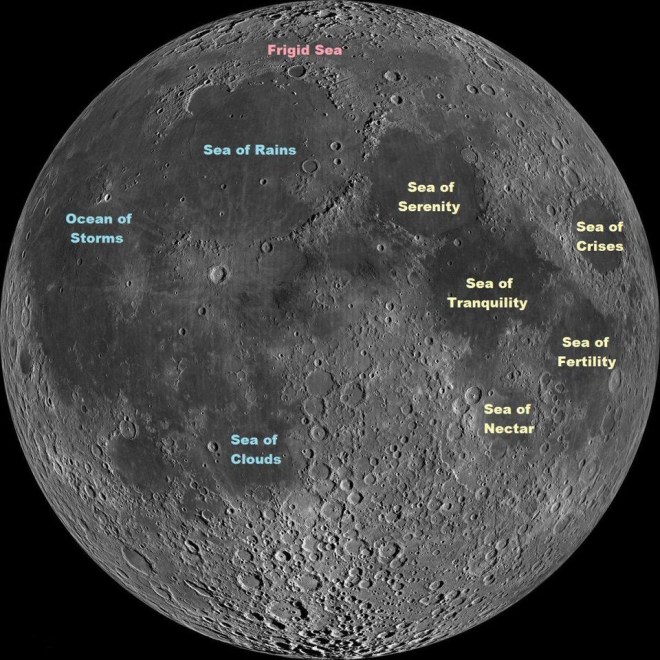
“The Moon’s biggest and most obvious features — visible even to the naked eye — are its large, flat, gray patches calledmaria (MAH-ree-a). This is the Latin plural of mare (MAH-ray), which means “sea.” Early telescope users thought these markings might be similar to Earth’s bodies of water.”

In 1651, the Italian astronomer Giambattista Riccioli gave them fanciful names such as Mare Tranquillitatis (“Sea of Tranquillity”) and Oceanus Procellarum (“Ocean of Storms”)

“Astronomers soon realized, however, that the Moon has no water — but the names stuck. In fact, the “seas” are ancient lava flows that flooded most of the Moon’s lowlands between 3.8 and 3.1 billion years ago. The Moon map here identifies the major maria. These are the Moon’s most important geographical features, and even the smallest binoculars are enough for learning them.”

IMPACT SCARS

Moon crater

One of the most spectacular crater chains stretches south from Ptolemaeus, near the center of the Moon. The Straight Wall is the Moon’s most prominent fault.

The Moon’s most famous landforms, of course, are its craters. Practically all of these are the scars of titanic impacts by asteroids or comet heads. Most occurred more than 3.9 billion years ago during the “era of heavy bombardment” early in the solar system’s history.

Earth was bombarded just as heavily, but Earth’s wind, water, and geologic activity have erased almost all trace of its early craters. The Moon, on the other hand, is geologically dead. We see on the Moon a record of what happened in the extremely ancient past, right there in stark view.

Below- NASA’s animation of the entire 4.5-billion-year history of the moon boiled down into 2.6 minutes:

signs of season logo

What are you seeing in nature? It can be from your own backyard, the local park, out on a hike or anywhere. What plants and animals catch your interest? What do you find interesting in nature? Take a photo, write a post, a story, a poem, anything goes because I love to see what Mother Nature is up to in your area. PS..please check back and visit bloggers who post later in the week!

Have a wonderful week from Michelle


The stars began to burn through the sheets of clouds, and there was a new voice…Mary Oliver

I spent some time outside that I really needed….these are my photos from a more peaceful time.

The Journey by Mary Oliver

One day you finally knew
what you had to do, and began,
though the voices around you
kept shouting
their bad advice – – –
though the whole house
began to tremble
and you felt the old tug
at your ankles.
‘Mend my life!’
each voice cried.
But you didn’t stop.

You knew what you had to do,
though the wind pried
with its stiff fingers
at the very foundations – – –
though their melancholy
was terrible. It was already late
enough, and a wild night,
and the road full of fallen
branches and stones.

But little by little,
as you left their voices behind,
the stars began to burn
through the sheets of clouds,
and there was a new voice,
which you slowly
recognized as your own,
that kept you company
as you strode deeper and deeper
into the world,
determined to do
the only thing you could do – – – determined to save
the only life you could save.