Wild Quinine-Parthenium integrifolium 

Parthenium integrifolium 

Wild Quinine

Also known as wild feverfew, wild quinine (Parthenium integrifolium) has a long history of medicinal use by Native Americans and the US Army. During World War I, wild quinine was used as a substitute for the bark of the Cinchona tree—as the active ingredient of quinine used to treat malaria.

The plant seems to have no trouble with heat—blooming June through September in hot, sunny locations. While the plant is not especially showy, the tiny white clusters of flowers attract nearly every walk of life. The plant is especially valuable for its support of native bees, attracting sweat bees (HalictusLassioglossum, and Agapostemon), mining bees (Andrena), small carpenter bees (Ceratina) and yellow-faced bees (Hylaeus) just to name a few.

Wild quinine is a fly favorite, attracting soldier flies (Stratiomys and Odontomyia), Syrphid flies (Syrphidae), Tachnid flies (Tachnidae), and others. Far from the common housefly, these flies are both pollinators and predators. In their larval form, many of these flies are valuable pest-eating insects.

Common Name: wild quinine
Type: Herbaceous perennial
Family: Asteraceae
Native Range: Eastern United States to Wisconsin and Arkansas
Zone: 4 to 8
Height: 2.00 to 4.00 feet
Spread: 1.00 to 2.00 feet
Bloom Time: May to August
Bloom Description: White
Sun: Full sun
Water: Dry to medium
Maintenance: Low
Flower: Showy, Good Cut, Good Dried
Leaf: Fragrant
Tolerate: Drought, Erosion, Clay Soil, Dry Soil, Shallow-Rocky Soil
Culture

Easily grown in average, dry to medium, well-drained soil in full sun.

Noteworthy Characteristics

Parthenium integrifolium, commonly called American feverfew, is a clump-forming, Missouri native perennial which occurs in dry soils on prairies, glades and rocky woods. Grows 3-4′ tall. Woolly-looking, white flower heads, each with 5 tiny ray flowers (1/12″ long), appear in broad, flat-topped, terminal corymbs from late spring to late summer. Leaves are aromatic, toothed and rough. Long-petioled basal leaves are much larger than stem leaves. Since the leaves of this species are in fact coarsely toothed, it remains an enigma as to why the plant was assigned the species name of integrifolium which means entire (i.e., margins lack lobes or teeth). Plant is also sometimes commonly called wild quinine. Former medicinal use as a diuretic.

Genus name comes from the Greek meaning virgin (only ray flowers are fertile).

Specific epithet means with an entire or uncut leaves but this species is coarsely toothed.

Problems

No serious insect or disease problems.

Garden Uses

Best in native plant, wild or cottage gardens or as part of a naturalized, meadow or prairie planting. Can be used in borders, but is minimally ornamental.
 

Eastern beebalm-Monarda bradburiana

Monarda bradburiana

Eastern beebalm

Native to North America

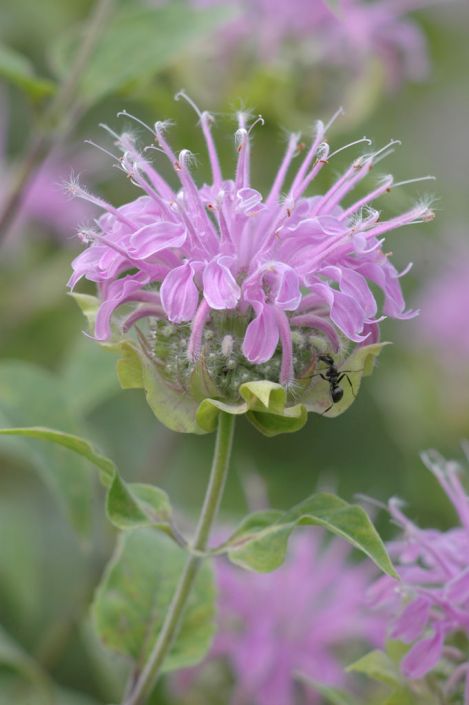
FIRST IMPRESSIONS:  Monarda bradburiana is a compact clumping perennial wildflower. Plants have gray-green aromatic leaves on strong square stems.  In late spring, stems are topped by showy rounded clusters of pale pink tubular flowers speckled with purple.  Pollinators flock to the blooms in sunny or partly shaded gardens with average well drained soils.

HABITAT & HARDINESS:  Monarda bradburiana occurs in the central and southern United States from Indiana to Alabama and west to Kansas, Arkansas and Texas.  The greatest distribution is in Illinois, Missouri and Arkansas.

This species is indigenous to savannas, rocky upland forests, thickets, limestone or sandstone glades, woodland meadows, bluffs, roadsides and abandoned fields.

Plants are hardy from USDA Zones 5-8.

PLANT DESCRIPTION:  Monarda bradburiana is an upright bushy perennial with square green stems.

The aromatic leaves are opposite and sessile or almost so.  The blades are gray-green and lanceolate to ovate.  They are over 3” long and about 2” wide with toothed edges and pointed tips.

The stems terminate in dome shaped 2-3” flower clusters.  The flowers are tubular, fragrant and about 1” long.  Each corolla tube is actually a ring of united petals with soft pinkish-lavender color and purple spots.  The tubes are pubescent with lobes toward the tip and exserted stamens.

The flowers are born in a ring on each dense head-like cyme.  The lobes and stamens of individual flowers give the flower clusters a ragged appearance.

Blooming lasts for about 3-4 weeks and is followed by ovoid nutlets that are nestled into the head-like cyme.

Plants grow 1-2’ tall with an equal spread.

CULTURAL & MAINTENANCE NEEDS:  Monarda bradburiana thrives in sun or part shade with well drained soil.  Plants tolerate drought and shallow rocky infertile soils.

Plants bloom more vigorously if they are divided in spring or fall every 3-4 years.

This species is resistant to powdery mildew. Irrigation during drought and pruning to thin dense growth helps to enhance the resistance.

The aromatic foliage is unpalatable to deer, rabbits and other herbivores.

LANDSCAPE USES:  This is a good choice for a Wildlife Garden, Cut Flower Garden, or Meadow. Plants are also used as Butterfly Nectar Plants or as part of a Grouping or Mass Planting.   Monarda bradburiana has Showy Blooms and is appropriate for Cottage Gardens, Deer Resistant Plantings, Water-wise Landscapes, Low Maintenance Plantings and Perennial Borders.

COMPANION & UNDERSTUDY PLANTS:  In sunny sites try pairing Monarda bradburiana with Coreopsis tripteris, Rudbeckia hirta, Liatris spicata and Sporobolus heterolepis.

Monarda fistulosa has similar appearance and culture and could be substituted in some situations.

TRIVIA:  Long tongued bees, butterflies, skippers, hummingbird moths and hummingbirds sip nectar from the flowers.  Caterpillars of several moth species feed on the foliage.  The aromatic leaves and stems are unpalatable to deer and other herbivores.

Monarda bradburiana is touted by many as a superior beebalm for the garden.   Attributes include its mildew resistance, short stocky stature, earlier bloom time and less aggressive spreading than other Monarda spp.

Renowned garden designer Piet Oudolf used Monarda bradburiana in his plans for New York City’s Highline and Chicago’s Lurie Garden.

The species was formerly known as Monarda rigida and Monarda villosa.


Height:

1-2 ft

Spread:

1-2 ft

Spacing:

18 in

USDA Hardiness Zone:

5-8

Bloom Color:

Pink, White


Monarda bradburiana Characteristics

Attracts Wildlife

  • Butterflies
  • Pollinators
  • Hummingbirds

Attributes

  • East-Coast Native
  • Drought Tolerant
  • Cut Flower
  • Clay Soil
  • Rock Garden
  • Naturalizing
  • Fragrant

Exposure

  • Full Sun to Partial Shade

Deer Resistant

  • Deer Resistant

Flowering Months

  • May

Foliage Color

  • Gray-Green

Groundcover Foot-Traffic Tolerances

  • Light

Growth Rate

  • Medium

Juglans nigra Tolerance (Black Walnut)

  • Yes

Season of Interest (Foliage)

  • Spring

Soil Moisture Preference

  • Dry to Moist

Plants for Pollinators: Beardtongue

Plants for Pollinators: Beardtongue

This post is part of an ongoing series highlighting some of the best plants for pollinators from coast-to-coast. Drawing from our books 100 Plants to Feed the Bees, Gardening for Butterflies , and our Monarch Nectar Plant Guides.


Beardtongue

Beardtongue gets its name for the hairs that line the protruding lower petal of these tubular plants. These hairs serve an interesting function, forcing bees deeper into the flower where they have to struggle a bit to emerge, firmly adhering pollen to themselves in the process.

Foxglove beardtongue (Penstemon digitalis) has another interesting feature, nectar guides. If you look into the tubular flowers you’ll notice several distinct lines leading to the back of the flower. These lines act like runway lights, advertising to bees that “the good stuff is back here!”

The nectar guides are clearly visible in the photo at left, as are the hairs that give beardtongue its name. These hairs coax bees forward, deep into the flower allowing the anthers to wrap around the bee and deposit their pollen. Photo: Justin Wheeler

Like Culver’s root, beardtongue fills a critical role, providing pollen and nectar at a time when resources are dwindling at the end of spring. Their long bloom time can stretch between late spring and mid-summer when other plants are just beginning to bloom. Beardtongue is easy to add to the landscape as it’s one of the smaller wildflowers. Low growing foliage is topped by flower masses that reach around 2’ in height and give way to seed heads that are enjoyed by birds late in the season. Beardtongue is visited by a number of bees including sweat bees, leafcutter bees, and is frequented by newly hatched bumble bees.

Native Range: There are roughly 150 species of Penstemon in North America, and many varieties are available in the nursery trade. Flowers range in color from pink, red, blue, white, purple, and seemingly every shade in-between. Blue and white flowers seem to attract the most pollinators. Hairy beardtongue (Penstemon hirsutus) is native predominately in the Northeastern U.S. and Canada, as far west as the Great Lakes region. Penstemon digitalis extends a bit farther west and as far south as Texas. Many western species exist and are often drought-tolerant selections.


Best For: Providing important late spring/early summer resources. A prolific nectar producer, it is visited by a huge diversity of butterflies, moths, and bees.