Nature Notes (#470)~The order Odonata (“toothed ones”) includes some of the most ancient and beautiful insects that ever roamed Earth,

nature notes logo

Join Nature Notes from Mondays at 11:00 pm EST  to Friday at 11:00 pm EST.

More information can be found at the top of the blog on a separate page, but it really is easy. What are you or have you seen and enjoyed in nature? It can be from your own backyard, the local park, out on a hike, or anywhere. What plants and animals catch your interest? Do you garden? Have you read a good book on nature? 

Write a blog post with a photo, a story, a poem, anything goes because I love to see what Mother Nature is up to in your area. Please submit one blog post per week and link it back to Nature Notes in some way.

Below is last week’s Nature Notes’ blogger thumbnail photos in a collage. If your photos are protected and/or you don’t want me to use them, please let me know. Also listed are all the links to last week’s Nature Notes blog posts if you missed any.—

*******

I am fortunate to be able to see these wonderful insects because of the pond.

The order Odonata (“toothed ones”) includes some of the most ancient and beautiful insects that ever roamed Earth, as well as some of the largest flying invertebrates ever to have lived.

Odonata consists of three groups: Anisoptera (which includes dragonflies), Zygoptera (which includes damselflies), and Anisozygoptera (a relict group represented by only two living species. This order is very diverse with about 5000 species, and its members are easy to observe.

How to tell the difference between the dragonfly and damselfly..

There are four details that even the most inexperienced bug-watcher can use to identify if the insect is a dragonfly or a damselfly. They are the eyes, body shape, wing shape, and position of the wings at rest.

Dragonflies have much larger eyes than damselflies, with the eyes taking up most of the head as they wrap around from the side to the front of the face. The eyes of a damselfly are large, but there is always a gap of space between them.

Dragonflies have bulkier bodies than damselflies, with a shorter, thicker appearance. Damselflies have a body made like the narrowest of twigs, whereas dragonflies have a bit of heft.

dragonfly male Blue Dasher.

Both dragonflies and damselflies have two sets of wings, however they have different shapes. Dragonflies have hind wings that broaden at the base, and which makes them larger than the front set of wings. Damselflies have wings that are the same size and shape for both sets, and they also taper down as they join the body, becoming quite narrow as they connect.

Finally, you can spot the difference when the insect is at rest. Dragonflies hold their wings out perpendicular to their bodies when resting, like an airplane. Damselflies fold their wings up and hold them together across the top of their backs.

Blue-fronted Dancer -Argia apicalis

The colorful, acrobatic dragonfly may seem familiar, but this stunning macro film reveals the mysteries behind its metamorphic life cycle—and some surprising adaptations

What are you seeing in nature? It can be from your own backyard, the local park, out on a hike or anywhere. What plants and animals catch your interest? What do you find interesting in nature? Take a photo, write a post, a story, a poem, anything goes because I love to see what Mother Nature is up to in your area. PS..please check back and visit bloggers who post later in the week!——

Have a wonderful week and stay safe…
Nature Notes (# 448)~Weather Radars Reveal an 80 Percent Chance of … Dragonflies?

Join Nature Notes Sunday at 12:00 am EST to Friday at 11:00 pm EST. More information can be found at the top of the blog on a separate page, but it really is easy. What are you or have you seen and enjoyed in nature? It can be from your own backyard, the local park, out on a hike or anywhere. What plants and animals catch your interest? Do you garden? Have you read a good book on nature? Write a blog post with a photo, a story, a poem, anything goes because I love to see what Mother Nature is up to in your area. Please submit one blog post per week and link back to nature notes in some way.

1. Shiju Sugunan 6. A Quiet Corner 11. samyuktha
2. Pictografio 7. orchid( apan) 12. image- in- ing: weekly photo linky
3. Day One 8. betty – NZ 13. craftygreenpoet
4. Sallie (Full Time- Life) 9. JELLYFISH 14. Sherrie
5. islandrambles 10. JEWEL BUG

Weather Radars Reveal an 80 Percent Chance of … Dragonflies? – 


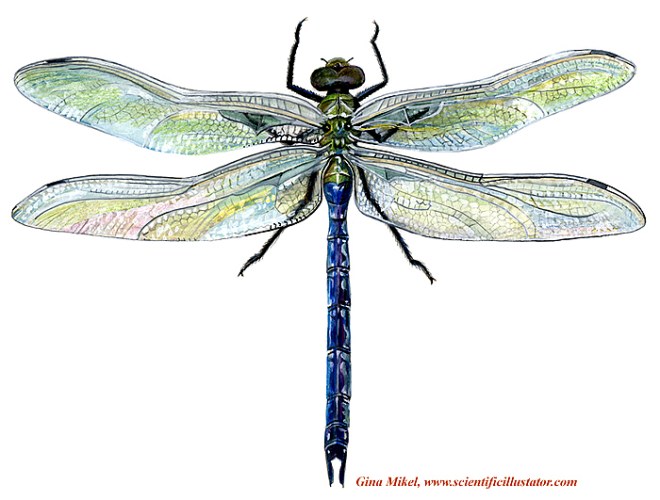
Birds aren’t the only ones who seek warmer climates during the winter months; many species of dragonflies also migrate each year. In fact, as many as 50 of the estimated 5,200 dragonfly species in the world migrate, following topographical features such as rivers and coastlines. Experts know little about dragonfly migration, but they are beginning to monitor patterns, noting that cold fronts usually trigger the migration process.

Each spring and fall, large dragonflies called green darners fly across North America. A green darner can travel as far as 900 miles on its two-inch wings, fluttering from Canada to the Gulf of Mexico. They are some of the most abundant dragonflies on the continent — but few people notice this mass migration.

Green Darner Dragonfly-Anax junius

Unlike monarch butterflies and songbirds, whose long-distance migrations draw crowds, green darners are inconspicuous travelers. These dragonflies rarely migrate in huge swarms. Radiant up close — emerald green at the thorax, splashes of blue on the abdomen — a three-inch-long dragonfly becomes a speck at a hundred yards. Even dragonfly experts have had little luck observing this cross-continental journey.

Citizen Science data has allowed scientists to figure out what types of natural cues, like temperature, give the dragonfly larvae the signal to emerge and migrate. Between February and March, the first generation of dragonflies emerges from ponds and lakes in the southern United States, Mexico and the Caribbean. Then those resilient first-gen bugs travel hundreds of miles north as, making it to New England or the upper Midwest by May. When they get there, they’ll lay their eggs and die.

green darner dragonfly migration map

The lives of the next generation are just as incredible. While some of those second generation insects will hang out and overwinter in ponds and lakes in the north during their nymph stage, many will reach maturity and head south between July and October.

When those insects reach the south, they deposit another batch of eggs, which mature into a third generation that will live a non-migratory life over the winter on the coast, producing the eggs of the dragonflies that will migrate northward again in the spring.

Doug Kahn, a meteorologist at the National Weather Service in Cleveland, saw several bluish masses shifting and swelling over Ohio. The undulating blobs on the radar were not storm clouds or a weather system, but a swarm of dragonflies.

“There are millions of them,” he said. “That is why you can see so many of them on the radar.”

Swarms of dragonflies captured on radar by the National Weather Service in Cleveland.CreditCreditNOAA

Radars like the ones used by the Weather Service are often used to track the seasonal movements of bees, birds, flies and other airborne creatures. Migration is common in insects and birds, according to Sara Kross, director of the master’s program in ecology, evolution and conservation biology at Columbia University.

“There are species that will migrate and those that will move due to the weather patterns,” Dr. Kross said.

“We now can predict when we will see waves of birds all through radar and knowledge,” she continued. “Right now, because of radar, we can see it happening in real time.”

It is the same science used to detect precipitation. “Insects are usually kind of longer” than a raindrop or a snowflake, Mr. Kahn explained. That results in a higher ratio of length to the height.

“If we see a thunderstorm, the radar sends up a beam and it hits clouds in the sky and it returns that imaging to us,” Mr. Kahn said. The only difference with insects is that the radar bounces off the millions of tiny bodies in the swarm.

It appears none of the swarm occurrences are rare.

“Picking up on the sheer scale of migration is something you can deduce from data,” Dr. Kross said. “But having radar really shows the intricacies of those movements.”


Nature walks are wonderful. But you don’t have to travel to special location to enjoy Mother Nature. There is so much to see in your own neighborhood or even in your own back or front yard. Get a guide-book of the wildlife in your area and learn the calls of birds and frogs and toads. So many times I hear a bird that lets me know what I am looking for in the trees.

Have a wonderful week from Michelle!

Nature Notes (#438)~Damselflies are similar to dragonflies, but are smaller, have slimmer bodies, and most species fold the wings along the body when at rest.

Join Nature Notes Tuesday at 12:00 am EST to Friday at 11:00 pm EST. More information can be found at the top of the blog on a separate page, but it really is easy. What are you or have you seen and enjoyed in nature? It can be from your own backyard, the local park, out on a hike or anywhere. What plants and animals catch your interest? Do you garden? Have you read a good book on nature? Write a blog post with a photo, a story, a poem, anything goes because I love to see what Mother Nature is up to in your area. Please submit one blog post per week and link back to nature notes in some way.

1. Shiju Sugunan 5. orchid( Japan) 9. islandrambles
2. Two For The Road 6. Birgitta B. 10. betty – NZ
3. Pictografio 7. Raquel Jimenez 11. Z for ZOOLOGY
4. Day One

Damselflies are insects of the suborder Zygoptera in the order Odonata. They are similar to dragonflies, which constitute the other odonatan suborder, Anisoptera, but are smaller, have slimmer bodies, and most species fold the wings along the body when at rest.

It went from cold and rainy to beastly hot and humid with high heat warnings. Today was the first day I was able to sit on my deck with cool enough temperatures that I wouldn’t over heat and a breeze to keep the bugs away… But it is July already.

Then I love to walk around the yard and look at the wildlife that is visiting…Something caught my eye and I had my camera in my pocket… Tiny…..In the grasses along the driveway..


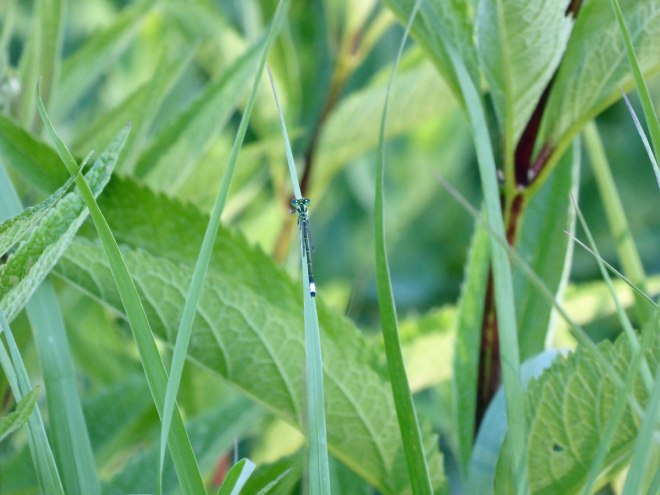
A flash of green caught my eye and I found a tiny damselfly hanging on to one of the grasses….

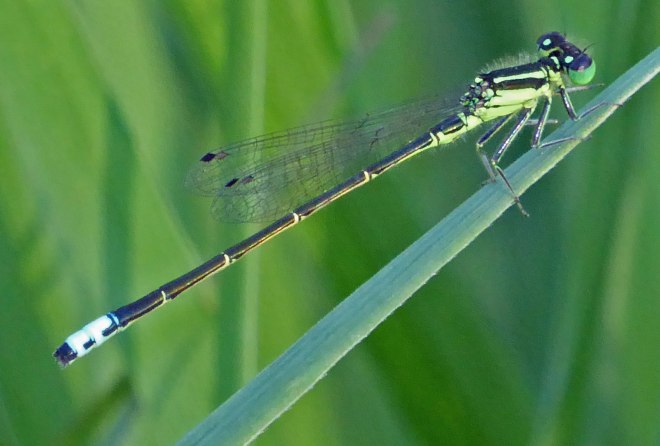
You can see how large the other plants leaves look in comparison. And this was in the front yard, not the back where the pond is. It is a fragile forktail (Ischnura posita) and the “forktail”  comes from tiny projections off the tip of males’ abdomens, which help to identify the species. The length of the body varies from 0.8 to 1.1 inches.

It is in the  Pond Damselfly (Coenagrionidae) family that encompasses most of the common damselflies seen at ponds and other still waters. However, some species, particularly Dancers, prefer a stream habitat. Coenagrionidae tend to be smaller, shorter-legged and often more brightly colored than other damselflies. Some present a real challenge for field identification because they demonstrate color changes with age, and/or two or three color forms of females.

Nature walks are wonderful. But you don’t have to travel to special location to enjoy Mother Nature. There is so much to see in your own neighborhood or even in your own back or front yard. Get a guide-book of the wildlife in your area and learn the calls of birds and frogs and toads. So many times I hear a bird that lets me know what I am looking for in the trees.