
Join Nature Notes Tuesday at 12:00 am EST to Friday at 11:00 pm EST. More information can be found at the top of the blog on a separate page, but it really is easy. What are you or have you seen and enjoyed in nature? It can be from your own backyard, the local park, out on a hike or anywhere. What plants and animals catch your interest? Do you garden? Have you read a good book on nature? Write a blog post with a photo, a story, a poem, anything goes because I love to see what Mother Nature is up to in your area. Please submit one blog post per week and link back to nature notes in some way.

—
| 1. | Sallie (Full Time- Life) | 6. | Day One | 11. | O for OLIVE |
| 2. | Shiju Sugunan | 7. | Raquel Jimenez | 12. | ORANGE ORCHID |
| 3. | Pictografio | 8. | orchid( Japan) | 13. | Jutta K. Germany |
| 4. | Adam Jones | 9. | Letting Go of the Bay Leaf – Be the Tapestry | 14. | junieper2 |
| 5. | Pat from Mille Fiori Favoriti | 10. | A Quiet Corner | 15. | MP UPPAL- You and I – India |
We have had a lot of rain…a lot of rain and my 4 year old grandson wanted to pick up and examine all the worms that were out on the driveway. I didn’t know why there were always so many after a rain or much about them at all….
Earthworms: A Garden’s Friend of Foe? That depends.
Here are 10 things you may want to know about earthworms:
1. Earthworms come in a seemly infinite variety—around 6,000 species worldwide.
One of the most familiar of them, the sort you may see in your garden, is commonly known as the night crawler (it typically surfaces after dark), the angleworm (its makes popular bait for fishing) or the rain worm (it leaves waterlogged soil after storms).
2. Of the more than 180 earthworm species found in the U.S. and Canada, 60 are invasive species, brought over from the Old World, including the night crawler.
3. Lacking lungs or other specialized respiratory organs, earthworms breathe through their skin.
4. The skin exudes a lubricating fluid that makes moving through underground burrows easier and helps keep skin moist. One Australian species can shoot fluid as far as 12 inches through skin pores.
5. Each earthworm is both male and female, producing both eggs and sperm.
They mate on the surface of the earth, pressing their bodies together and exchanging sperm before separating. Later, the clitellum (a collar-like organ that goes around the worm’s body the way a cigar band does a cigar) produces a ring around the worm. As the worm crawls out of the ring, it fills the ring with eggs and sperm. The ring drops off, seals shut at the ends and becomes a cocoon for the developing eggs.
6. Baby worms emerge from the eggs tiny but fully formed. They grow sex organs within the first two or three months of life and reach full size in about a year. They may live up to eight years, though one to two is more likely.
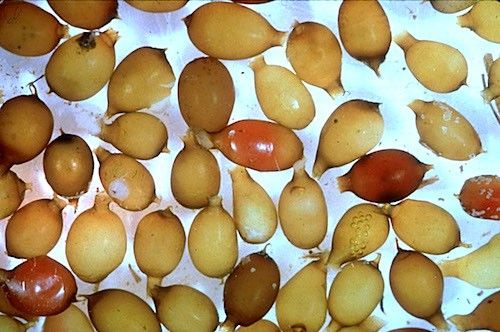
earthworm egg case
7. Full size for an earthworm varies among species, ranging from less than half an inch long to nearly 10 feet. The latter monsters don’t occur in U.S. backyards—you’ll have to go to the Tropics to see one of them. The homegrown versions top out at around 14 inches.
8. The glaciers that crawled across Canada into the northern tier of the lower 48 states during the most recent ice age wiped out earthworms in those areas.
In other parts of the U.S., you may find native earthworm species, but the worms living in the regions scoured by glaciers are invaders from overseas, brought here intentionally by early settlers on the assumption that the worms would improve the soil, or carried accidentally in shipments of plants or even in dirt used as ballast in ships.
9. The earthworm’s digestive system is a tube running straight from the mouth, located at the tip of the front end of the body, to the rear of the body, where digested material is passed to the outside. Species vary in what they eat, but by and large their devouring of fallen leaves and/or soil allows the worms to move nutrients such as potassium and nitrogen into the soil.
Also, worm movements within the Earth create burrows that encourage the passage of air and a loosening of the soil. Good things, right? Well, maybe not. Which brings us to 10 …
10. The northern forest evolved after the glaciers retreated, yielding an ecosystem that does not benefit from earthworms. These forests require a deep layer of slowly decomposing leaves and other organic matter called “duff” that overlays the soil. When earthworms invade these forests, they quickly eat up the duff, with the result that nutrients become less available to young, growing plants and the soil, instead of aerating and loosening, becomes more compact.
The combined effects of such developments have resulted in damage to trees such as sugar maples and to many forest herbs and understory plants, such as trillium, rare goblin ferns, trout lilies and other forest-floor species. In some areas, oak forests have been overrun by buckthorn, and in others the presence of earthworms has allowed the invasion of Japanese barberry.
As duff disappears, so do the insects and other small creatures that depend on it for survival, with the result that animals such as salamanders lose a key food source and face population declines. Earthworm burrows also may speed the passage of water through forest soil, another change that might be a benefit to farmland or a garden with compacted soil but that is a negative in a northern forest.
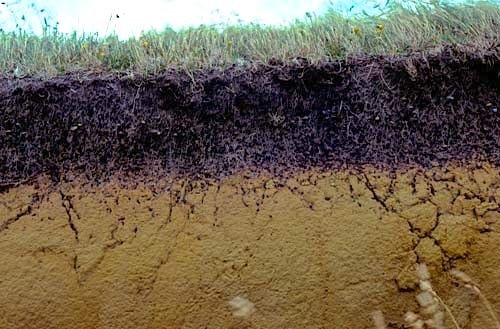
Earthworm movements within the Earth create burrows that encourage the passage of air and loosening of the soil.
BONUS FACT
Although eradicating earthworms in areas they have already invaded is virtually impossible in practical terms (the measures that wipe out earthworms, such as spraying with pesticides, also kill many other species), we can all help protect as-yet un-invaded ecosystems by keeping worms out of such areas.
If you use earthworms for composting and live in a region near forests that have not been hit by earthworms, you can help by dropping use of the worms. Also, to avoid spreading earthworm eggs when fertilizing with composted materials, freeze your compost for at least a week before using it—freezing will kill eggs as well as the worms.
If you use earthworms for bait fishing, don’t dump leftover worms onto the soil at the end of a day’s fishing. Remove them from the site, or throw them far enough into a pond that they will die before they can reach to shore. When planting new shrubs or trees in your garden or yard, examine any Earth ball or potting soil for evidence of worms.

Why we see more earthworms after a Rain
Many earthworm and soil experts have settled on a version of this explanation: Moving around the soil is relatively slow and difficult, even for earthworms. They can cover a lot more ground on the surface. The problem is, earthworms need to stay moist. Most of the time, they would dehydrate if they were above ground.
But when it rains, the surface is moist enough for worms to survive and remain hydrated. For a few species, they can more easily move about and find mates. For other earthworms, it may well just be a way to disperse and move into new territory. They can migrate much longer distances than they ever could underground.
Of course, coming to the surface poses hazards. The earthworms are easy pickings for birds and other predators. In our urban and suburban world, they also get trapped on sidewalks, patios and roads. The worms I encountered this morning gave the impression that their migration strategy was a failed one. But most worms survive. They move across the lawn or park and burrow back into the soil without any problems.
There undoubtedly will be new research and new revelations about the lives and habits of earthworms. Nature’s mysteries are not just “out there” in the wilderness. The common creatures that live around us still hold surprises. Take a moment and observe the phenomenon happening in the natural world, right now, where we live. The surprises and wonders are right under our feet.
10 Interesting Facts About Earthworms. (2019). EcoWatch. Retrieved 20 April 2019, from https://www.ecowatch.com/10-interesting-facts-about-earthworms-1881871982.html

Nature walks are wonderful. But you don’t have to travel to special location to enjoy Mother Nature. There is so much to see in your own neighborhood or even in your own back or front yard. Get a guide-book of the wildlife in your area and learn the calls of birds and frogs and toads. So many times I hear a bird that lets me know what I am looking for in the trees.
 ramblingwoods.com