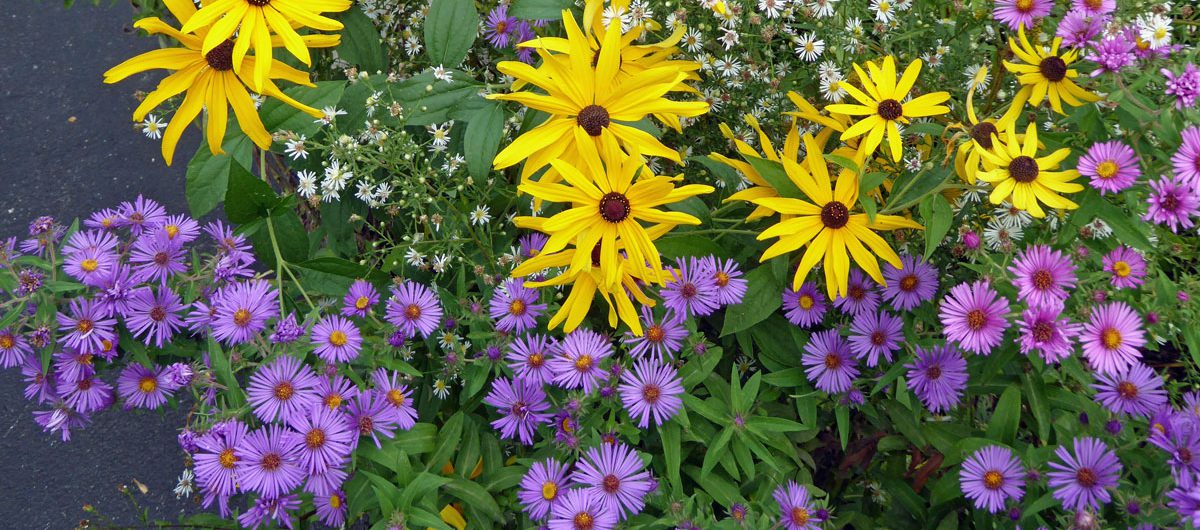

Join Nature Notes from Mondays at 11:00 pm EST to Friday at 11:00 pm EST.
More information can be found at the top of the blog on a separate page, but it really is easy. What are you or have you seen and enjoyed in nature? It can be from your own backyard, the local park, out on a hike, or anywhere. What plants and animals catch your interest? Do you garden? Have you read a good book on nature?
Write a blog post with a photo, a story, a poem, anything goes because I love to see what Mother Nature is up to in your area. Please submit one blog post per week and link it back to Nature Notes in some way.
Below is last week’s Nature Notes’ blogger thumbnail photos in a collage. If your photos are protected and/or you don’t want me to use them, please let me know. Also listed are all the links to last week’s Nature Notes blog posts if you missed any.

| 1. | viltogvakkert | 7. | Raquel | 13. | Buena Vida |
| 2. | Pictografio | 8. | Karen, Pixel Posts | 14. | A spirit of simplicity |
| 3. | Nature | 9. | A Quiet Corner | 15. | SEEDY |
| 4. | Sallie (Full Time- Life) | 10. | orchid( Japan) | 16. | Linda aka Crafty Gardener |
| 5. | betty – NZ | 11. | Cheryl Ann~ desert horses | ||
| 6. | Monika Ohson | Traveler In Me | 12. | Junieper/ Jesh |
—
We have had record-breaking low temperatures with freeze over the last week. Rain, sleet and snow making it a miserable week. I wanted to show you the canada goose who has nesting in our yard for the past 3 years. Thanks to Cornell for the facts. Stay well my friends….
Canada Geese-
The big, black-necked Canada Goose with its signature white chinstrap mark is a familiar and widespread bird of fields and parks. Thousands of “honkers” migrate north and south each year, filling the sky with long V-formations. But as lawns have proliferated, more and more of these grassland-adapted birds are staying put in urban and suburban areas year-round, where some people regard them as pests.
Behavior– During much of the year they associate in large flocks, and many of these birds may be related to one another. They mate for life with very low “divorce rates,” and pairs remain together throughout the year. Geese mate “assortatively,” larger birds choosing larger mates and smaller ones choosing smaller mates;
Food
In spring and summer, geese concentrate their feeding on grasses and sedges, including skunk cabbage leaves and eelgrass. During fall and winter, they rely more on berries and seeds, including agricultural grains, and seem especially fond of blueberries. They’re very efficient at removing kernels from dry corn cobs. Two subspecies have adapted to urban environments and graze on domesticated grasses year-round.

This pair had been nesting for 4 years and one nest was destroyed by a predator and another washed out when the pond was high. Last year was their first successful nest and out of 5 eggs, two goslings survived to adulthood. Predators of Canada geese and their eggs include humans, coyotes, raccoons, skunks, bobcats, and foxes,, eagles, hawks.
Nesting
NEST PLACEMENT
On the ground, usually on a muskrat mound or other slightly elevated site, near water. They prefer a spot from which they can have a fairly unobstructed view in many directions. The Female selects the site and does much of nest construction. She adds down feathers and some body feathers beginning after the second egg is laid. She does all the incubation while her mate guards her and the nest.
NEST DESCRIPTION
A large open cup on the ground, made of dry grasses, lichens, mosses, and other plant material, and lined with down and some body feathers. – Two to Eight eggs.
This is from last summer and is our trail cam at night. You can see the goose standing up as the raccoon will take eggs.
Conservation -The proliferation of lawns, golf courses, and parks offers Canada Geese such reliable habitat that in some areas the birds stay all year round instead of migrating like they used to do. Recently, some communities have had to begin considering some Canada Geese as nuisances (for eating grass or fouling lawns) or even hazards (around airports, where collisions with planes can be very dangerous). Some 2.6 million Canada Geese are harvested by hunters in North America, but this does not seem to affect its numbers.
My Opinion– We provide habitat by closely cut lawns and then get angry when the geese show up. Here all around the ponds, everything is mowed right to the water except for our part of the lawn which is a butterfly weed and wildflower garden where no geese go. I have never been smacked by a goose. I have been hissed at and I respect them especially in the breeding season. Here on the pond they have been illegally shot and beaten to death and I report that.
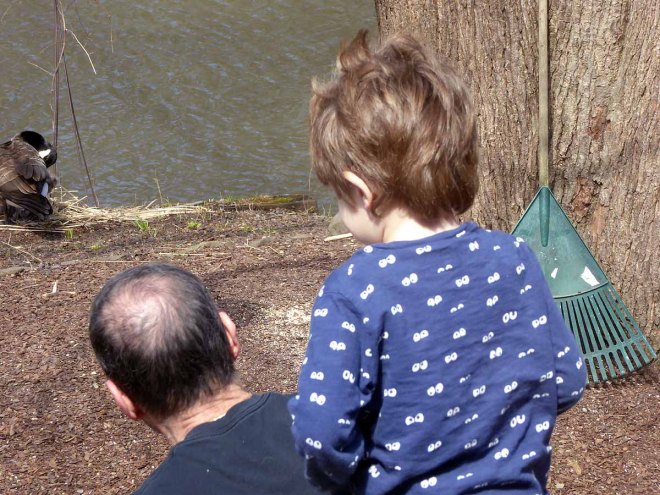
Part of our lawn is small to the pond and then extends across the pond and back into the wetland woods. My 5-year old grandson was able to watch the goose lay her eggs which is one every day. He was thrilled and you can see that the gander (male) was not attacking them because they know us.
24-28 days later the goslings hatch and may stay near the nest for a day or so living off of their yolk sac.
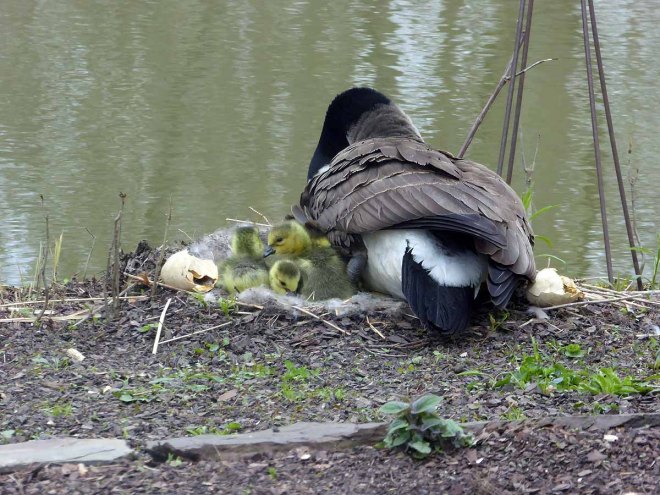
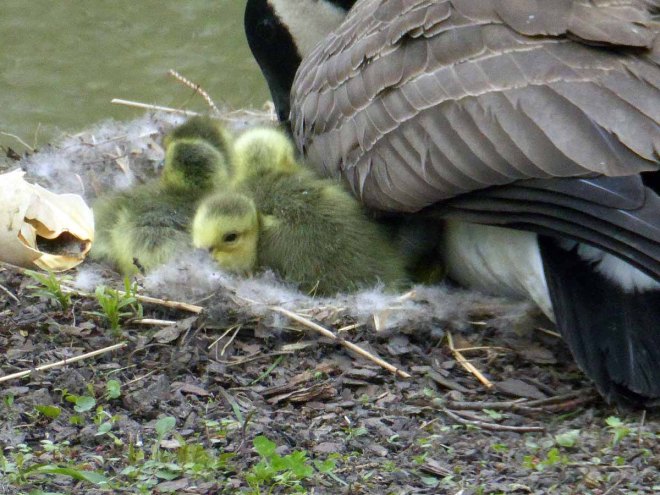
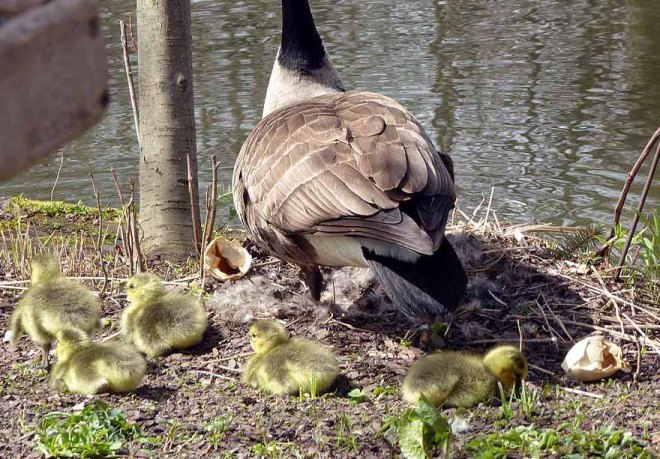
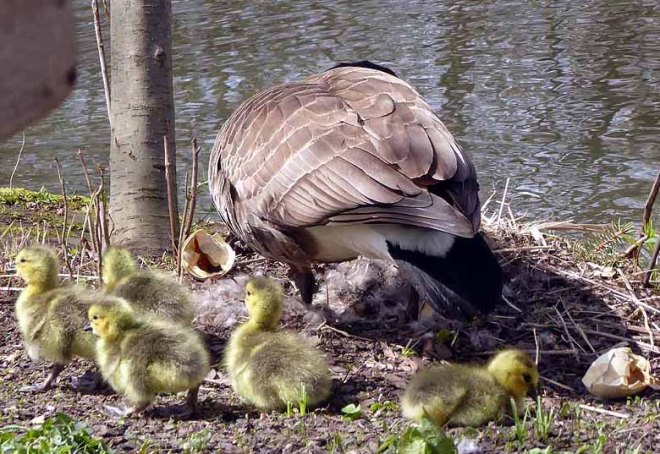
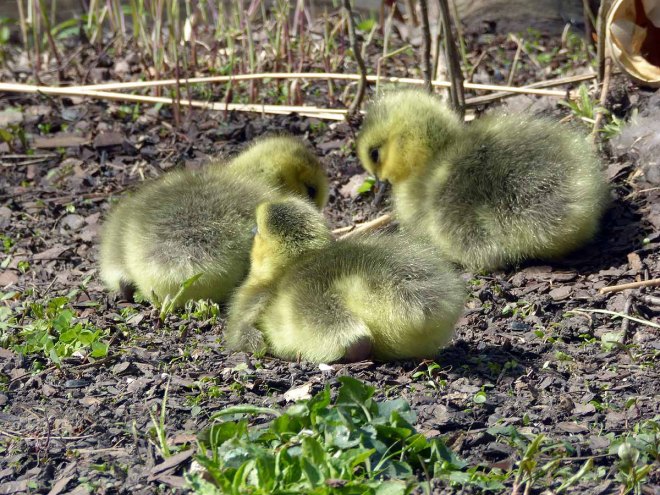
Six goslings

Goslings often remain with their parents for their entire first year, especially in the larger subspecies. As summer wanes birds become more social; they may gather in large numbers at food sources; where food is limited and patchy, may compete with displays and fights.
In winter, Geese can remain in northern areas with some open water and food resources even where temperatures are extremely cold. Geese breeding in the northernmost reaches of their range tend to migrate long distances to winter in the more southerly parts of the range, whereas geese breeding in southern Canada and the conterminous United States migrate shorter distances or not at all.
Migrating flocks generally include loose aggregations of family groups and individuals, in both spring and fall. Flights usually begin at dusk, but may begin any time of day, and birds fly both night and day. They move in a V formation, with experienced individuals taking turns leading the flock.

What are you seeing in nature? It can be from your own backyard, the local park, out on a hike or anywhere. What plants and animals catch your interest? What do you find interesting in nature? Take a photo, write a post, a story, a poem, anything goes because I love to see what Mother Nature is up to in your area. PS..please check back and visit bloggers who post later in the week!
Have a wonderful week from Michelle
 ramblingwoods.com