
Join Nature Notes from Monday at 12:00 am EST to Friday at 11:00 pm EST. More information can be found at the top of the blog on a separate page, but it really is easy. What are you or have you seen and enjoyed in nature? It can be from your own backyard, the local park, out on a hike or anywhere. What plants and animals catch your interest? Do you garden? Have you read a good book on nature?
| 1. | Pictografio | 6. | betty – NZ | 11. | SUMMER LEAF |
| 2. | Sallie (FullTime-Life) | 7. | orchid(Japan) | 12. | MERRY CHRISTMAS |
| 3. | Lisa | Handmade in Israel | 8. | A spirit of simplicity | 13. | islandrambles |
| 4. | Birgitta B. | 9. | A Green Ridge | ||
| 5. | Raquel | 10. | craftygreenpoet |
In 1996 an international consortium of conservation and nature organizations, citizen activists and government agencies named the Niagara River Corridor as the first internationally recognized “globally significant” Important Bird Area (NRCIBA).The area is recognized as important to a wide variety of resident and migratory birds, and the flora, fauna, and ecosystems that support these birds. A wide variety of bird species including neotropicals, travel through the corridor or breed here. Birds that depend upon this area for habitat include migrating and breeding songbirds, warblers, waterfowl, raptors, shorebirds, gulls and terns, and others. The corridor provides essential habitat. Over 30 species of endangered birds, threatened birds or birds of special concern are found here, including the bald eagle, the peregrine falcon, the black tern and the common tern.
Many fish, mammals, amphibians, insects and plants that are on the state Endangered, Threatened, or Species of Special Concern lists also can be found in the corridor.

Great Lakes in the US
I live near Lakes Erie and Ontario and close to the Niagara River that flows between them and makes the great Niagara Falls.

I live in a suburb of Buffalo New York about 45 minutes from Niagara Falls.
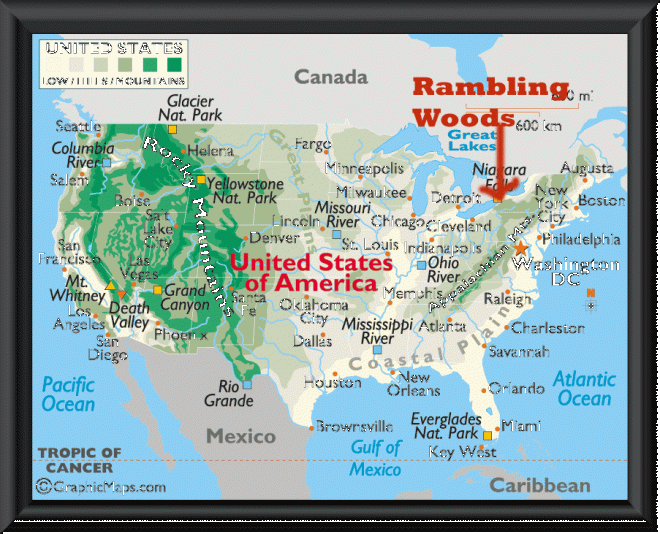
ramblingwoods-western New York state
Niagara River Corrridor.

Niagara River Corridor

Diving ducks are agile swimmers that dive far beneath the surface of the water in search of food, including fish, insects, and aquatic plants. These ducks prefer to stay in the water and can be ungainly and awkward on land, and they have to build up speed to take off from the water’s surface.
The most common bird species that can be spotted on the Niagara River in winter are canvasbacks, redheads, tundra swans, American wigeon, common goldeneye, long-tailed duck, greater and lesser scaup, white-winged scored, bufflehead, and common and red-breasted merganser. The birds adore this unfrozen open water for its rich food supplies, including aquatic plants, crustaceans, mollusks, and fish.
The following species feed mostly on aquatic plants such as eel-grass: canvasback, redhead, and tundra swan.


Crustaceans such as crayfish are the primary prey of common goldeneye and long-tailed duck.


The following species feed mostly on mollusks such as mussels and aquatic snails: greater and lesser scaup, bufflehead, and white-winged scoter.


Common and red-breasted mergansers feed primarily on fish. These are the only photos that I took and these were from these mergansers stopping tp fish during migration…


There are also gulls who are the first to arrive in mid-November. About 100,000 birds come from as far as Greenland and Siberia. Ornithologists count up to 19 species of gulls, but the most numerous are Bonaparte’s gulls, ranging from 50,000 to 70,000 in total, which is roughly 10% of the world’s population.
I was corrected years ago for referring to a gull I saw as a “seagull” and told that they were called “gulls”

bonaparte gull
This was a good lesson for me. It is funny what we don’t know about in our own area and when I can, I would like to go and look as we are 15 minutes from the Niagara River…

Have a wonderful nature-filled week! Please be safe.





 ramblingwoods.com