
Join Nature Notes from Mondays at 11:00 pm EST to Friday at 11:00 pm EST.
More information can be found at the top of the blog on a separate page, but it really is easy. What are you or have you seen and enjoyed in nature? It can be from your own backyard, the local park, out on a hike, or anywhere. What plants and animals catch your interest? Do you garden? Have you read a good book on nature?
Write a blog post with a photo, a story, a poem, anything goes because I love to see what Mother Nature is up to in your area. Please submit one blog post per week and link it back to Nature Notes in some way.
| 1. | Pictografio | 6. | Birgitta B. | 11. | CREEK |
| 2. | In Bloom | 7. | orchid( Japan) | 12. | craftygreenpoet |
| 3. | Sallie (Full Time- Life) | 8. | A spirit of simplicity | 13. | Sylvia D |
| 4. | betty – NZ | 9. | image- in- ing: weekly photo linky | 14. | A Quiet Corner |
| 5. | Pat — Colorado | 10. | AD PARNASSUM |
Bird Migration is underway and I am learning about how to follow it on radar……
BirdCast and Migration Conditions
Click here for an animated map of the United States showing today’s migration movements.
Find timely “birdcast” updates at Birdcast.info
The term “NEXRAD” stands for next generation radar and is used by avid birders and professional ornithologists to track migratory birds. The image below shows a NEXRAD image of the United States. The blue circles reflect the density of flocks of birds, bats, or insects as they migrate over a radar station. By analyzing looping sequences of these and other colorful maps, birders can reasonably forecast the density, location, direction and speed of birds during migration.

Being able to read and understand NEXRAD maps takes a little practice, and bird predictions always rely on some level of groundtruthing, but there are several resources on the web that can help.
The idea is to find a map of a region of the U.S. you are interested in tracking, such as the eastern half of the United States where you can pinpoint the arrival of migrants in the Gulf shore states and watch as the flocks (the blue blobs) move northward in spring (or retreat southward in the fall). Some birders also use NEXRAD to track night migration, thus finding opportune times to go outside at night to listen to nocturnal flight calls.
You can find a good selection of NEXRAD maps at the following links:
Department of Atmospheric and Oceanic Sciences
Birds and Radar Primer by BadBirdz Reloaded
This is also a good read:
Understanding Radar and Birds by ebird
Woodcreeper Radar Migration FAQ
Armed with the above information, you will well on your way to using NEXRAD as a tool for understanding seasonal migration cycles and can plan your birding trips accordingly.
Give NEXRAD a try.
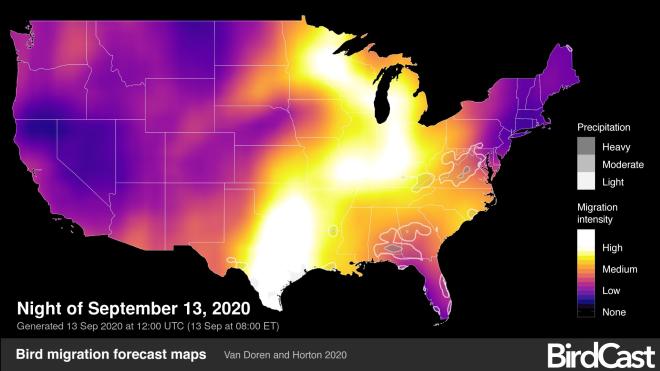
bird migration forecast for Sept 13
Bird migration forecasts show predicted nocturnal migration 3 hours after local sunset and are updated every 6 hours. These forecasts come from models trained on the last 23 years of bird movements in the atmosphere as detected by the US NEXRAD weather surveillance radar network. In these models we use the Global Forecasting System (GFS) to predict suitable conditions for migration occurring three hours after local sunset. These maps also show precipitation forecasts (outlined and shown in grayscale). Note, areas forecast to experience precipitation and bird migration may over
Migration tools
What are you seeing in nature? It can be from your own backyard, the local park, out on a hike, or anywhere. What plants and animals catch your interest? What do you find interesting in nature? Take a photo, write a post, a story, a poem, anything goes because I love to see what Mother Nature is up to in your area. ——

Have a wonderful week and stay safe…
 ramblingwoods.com