
Join Nature Notes from Mondays at 11:00 pm EST to Friday at 11:00 pm EST.
More information can be found at the top of the blog on a separate page, but it really is easy. What are you or have you seen and enjoyed in nature? It can be from your own backyard, the local park, out on a hike, or anywhere. What plants and animals catch your interest? Do you garden? Have you read a good book on nature?
Write a blog post with a photo, a story, a poem, anything goes because I love to see what Mother Nature is up to in your area. Please submit one blog post per week and link it back to Nature Notes in some way.
Below is last week’s Nature Notes’ blogger thumbnail photos in a collage. If your photos are protected and/or you don’t want me to use them, please let me know. Also listed are all the links to last week’s Nature Notes blog posts if you missed any.

| 1. | Nature Footstep | 7. | Margi | 13. | GATE |
| 2. | Sallie (Full Time- Life) | 8. | Sunrise | 14. | TOADSTOOL |
| 3. | Pictografio | 9. | orchid( Japan) | 15. | PARADOXICAL BLOSSOM |
| 4. | Raquel | 10. | Lisa | Handmade in Israel | 16. | A Quiet Corner |
| 5. | Karen, Pixel Posts | 11. | Vilt og vakkert | ||
| 6. | Pat — Colorado | 12. | PARKLANDS SUNRISE |
—
I don’t think I did a good job last week talking about wasps. I was trying to say that wasps like mud daubers and other “solitary” wasps are not aggressive and in some cases have no stingers and don’t defend their solitary nests. Now “social wasps are another matter. These are yellow jackets, hornets and paper wasps who live in a colony. I never noticed a bald-faced hornet nest, nor was I bothered by them even though in the fall there was a huge nest in our tree. I have only been stung by yellow jackets when I stumbled into a ground nest.
Here is how to stay safe…
The mob mentality of social wasps can create a furious swarm when even just a single insect is aggravated, here’s the reason and why it matters.-Treehugger
But the remarkable thing about wasps, as National Geographic points out, is this: Nearly every pest insect on the planet is preyed upon by a wasp species, either for food or as a host for its parasitic larvae. Wasps are so adept at controlling pest populations that the agriculture industry now regularly deploys them to protect crops.
From flies to beetle larvae to every kind of garden pest that vexes, it’s likely that their numbers are controlled by wasps. Plus, wasps offer some pollinating services as well. While not as effective at getting pollen from one place to another as bees, wasps still do their best. And some species are rock stars when it comes to pollinating – fig wasps, for example, are responsible for pollinating almost 1,000 species of figs.
It behooves us to do our best to get along with wasps, and part of that is better understanding their behavior. Social wasps in distress send out a pheromone that is like a 911 call to the nearby colony; the result is a swarm of pissed-off wasps in an aggressive frenzy. (See more about that in the video below.)
So the best thing to do is to avoid angering even a single wasp. The UC Davis Integrated Pest Management program offers these tips to avoid bees and wasps, noting that unless a person collides with or swats one, they are unlikely to sting (and/or get mad and send out a call to the troops).
How to avoid wasps
- Bees and wasps can be attracted to, or may react to, odors in the environment. It is best not to use perfume, cologne, or scented soaps if you are going into an area of bee and/or wasp activity.
- Avoid going barefoot in vegetation, especially clover and blooming ground covers.
- Also avoid wearing brightly colored or patterned clothing.
- If you remain calm when a bee or wasp lands on your skin to inspect a smell or to get water if you are sweating heavily, the insect eventually will leave of its own accord. If you don’t want to wait for it to leave, gently and slowly brush it away with a piece of paper.
- When swimming in pools, watch out for bees or wasps trapped on the surface of the water. If you find bees or wasps in the water, it’s best to remove them to avoid being stung.
- Stinging incidents often occur when nesting areas of social insects are disturbed. Be observant of the area around you. If you see insects flying to and from a particular place, avoid it.
And while not provoking wasps is good, for bees it may be even more important – wasps can sting over and over, but a bee stings once and then it dies.
And bee populations need all the help they can get. So respect the bees and wasps and they’ll continue playing their important roles in the ecosystem … and you may have a few less stings to agonize over.
Social Wasps-family Vespidae.
Social wasps such as the hornets, yellowjackets and paper wasps live in colonies in a fashion similar to the honey bees and ants. Most of the wasps in a colony are workers; i.e., the nest queen’s nonreproductive daughters that build the nest, gather food and care for the queen’s offspring.
paper wasp nest
Hornets build the familiar large nests of a paper-like material made from chewed wood mixed with saliva. Nests contain many tiers of cells covered by the outer shell with a single opening at the bottom. Hornet nests are usually located in wooded areas, attached to a tree branch, but may be attached to shrubs, utility poles or house siding. Each nest has only a few hundred workers that are about an inch long and dark with white, light yellow or cream colored markings on the abdomen, thorax, and face. Hornets can be aroused to sting in great numbers, but only when the nest is disturbed or threatened.
 yellow jacket
Yellowjackets are honey bee size (about 1/2 to 3/4 inch long) and black with bright yellow markings. (Honey bees are golden or brown.) Yellowjackets build paper nests similar to hornets but either in the ground, a log or landscape timber or building wall or attic. Yellowjackets are commonly observed hovering back and forth at the small nest opening or around garbage cans and other areas where they forage for food. Nests may contain up to 5,000 workers, most of which never travel more than a few hundred yards from the nest while looking for food. Yellowjacket stings are quite painful, but the wasps are usually not aggressive except when disturbed at the nest.
 yellow jacket nest
Paper wasps build the familiar umbrella shaped nests found hanging by a short stalk on the undersides of building eaves. Only a single tier of cells is constructed and there is no external covering over the nest. Each colony normally contains fewer than 25 wasps, but late in the season, the number may swell to over 100. Paper wasps are slightly longer and more slender than yellowjackets, and color is variable among the many species.
 bald-faced hornet
A social wasp colony lasts only 1 year. Paper wasps, hornets, and yellowjackets build a new nest from scratch each year and do not reuse the previous year’s nest. The only wasps to overwinter are the fertilized queens. All the workers from a colony die with the first frosts.
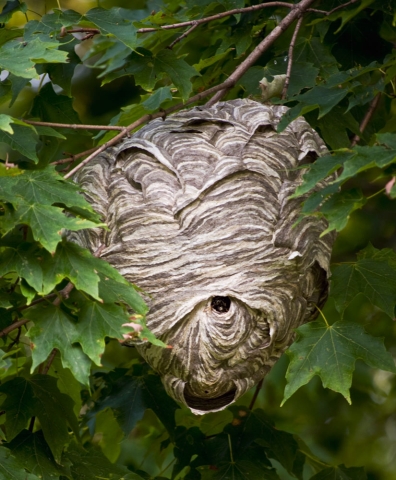 bald faced hornet nest
What are you seeing in nature? It can be from your own backyard, the local park, out on a hike or anywhere. What plants and animals catch your interest? What do you find interesting in nature? Take a photo, write a post, a story, a poem, anything goes because I love to see what Mother Nature is up to in your area. PS..please check back and visit bloggers who post later in the week!——-

Have a wonderful week from Michelle



 ramblingwoods.com