
Join Nature Notes from Mondays at 11:00 pm EST to Friday at 11:00 pm EST.
More information can be found at the top of the blog on a separate page, but it really is easy. What are you or have you seen and enjoyed in nature? It can be from your own backyard, the local park, out on a hike, or anywhere. What plants and animals catch your interest? Do you garden? Have you read a good book on nature?
Write a blog post with a photo, a story, a poem, anything goes because I love to see what Mother Nature is up to in your area. Please submit one blog post per week and link it back to Nature Notes in some way.
Below is last week’s Nature Notes’ blogger thumbnail photos in a collage. If your photos are protected and/or you don’t want me to use them, please let me know. Also listed are all the links to last week’s Nature Notes blog posts if you missed any.

| 1. | Pictografio | 5. | Karen, Pixel Posts | 9. | craftygreenpoet |
| 2. | Australia | 6. | Margi | 10. | RAINY DAY |
| 3. | betty – NZ | 7. | orchid( Japan) | 11. | MYSTERIOUS |
| 4. | Raquel | 8. | A spirit of simplicity |
Solitary Wasps……Unlike Yellow Jackets and others who have a large community nest or social wasps.

mud dauber wasp nest
Up in the corner of the front porch, I found a mud-dauber nest and as I watched, she came back to work on it. Mud daubers do not defend the nest and are not aggressive even though they can sting and are solitary wasp species. The single female will construct the nest using mud and make individual chambers where a single egg is laid with food, many times a spider. The cells are then sealed up and abandoned.

black and yellow mud dauber, Sceliphron caementarium
BLUE-MUD DAUBER WASP
I was able to watch a blue mud dauber, (Chalybion californicum) make her nest. These wasps are metallic blue, blue-green or blackish in color with very short narrow waists. During the summer, female blue mud daubers build nests by bringing water to abandoned mud nests made by other species of mud dauber wasps. They form new mud chambers, stock them with paralyzed spiders and a single egg, then seal the chambers with more mud. Their offspring stay in the chamber, feeding on the spiders, and then pupate in a thin silk cocoon. They spend the winter in the nest, emerging the following spring as adults.
Below- You can see the lighter colors of mud where the wasp has opened the old black and yellow mud dauber’s nest cells and softened the mud to reuse it for her eggs.
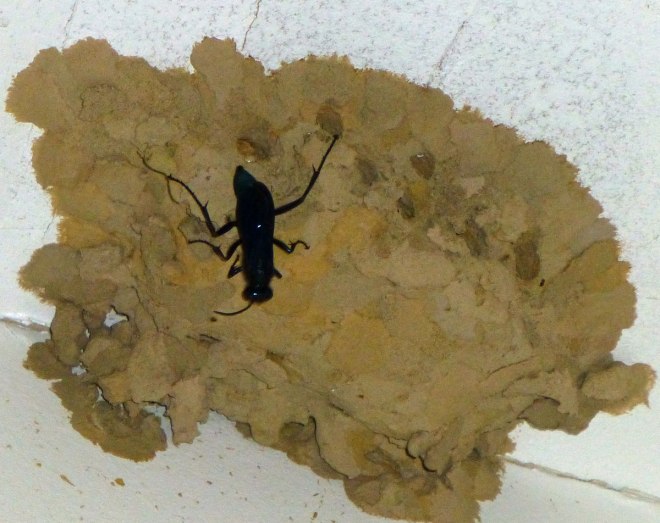
Blue Mud Dauber Wasp
ORGAN PIPE or PIPE ORGAN WASP
Pipe Organ wasps are very “laid back” and rarely offer to sting anyone. They are quite large, and they are not intimidated by your presence, so, if they fly around you, they might be a bit frightening. However, there is nothing to fear….unless you want to try to hold them in your hand. They just “look you over,” then go about their business of building and provisioning their nests.

old organ pipe mud dauber nest
These creatures are also known for the architecture of their nests, which are tubular in style, and remind folks of organ pipes, hence another name. They make these nests of mud, which gives us a third name for them. Actually, they prefer high-quality clay, and have been known to lead people to clay deposits for use by potters.
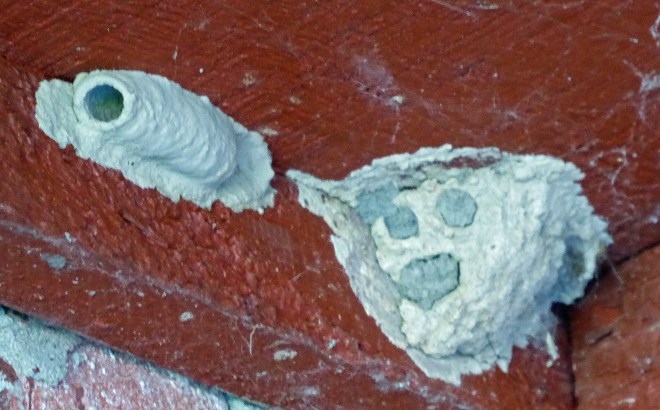
Left- Pipe Organ Nest-Right-Mud Dauber Nest
Above these nests look very large but they aren’t at all. The one on the right has been reused for 4 years now by a blue mud dauber wasp who has taken the old nest. The lighter colors are holes with new mud. The nest on the left was made by an organ pipe mud dauber this week in one day. One day? I mean and the workmanship of these insects is amazing…
Something I learned in my research is that wasps are pollinators. According to my friend Dr. Beatriz Moisset
Wasps are very important pollinators. Wasps are insects, in the same Order, Hymenoptera, as bees and ants. Most familiar wasps belong to a group called the Aculeata. The word “Aculeata” refers to the defining feature of the group, the modification of their ovipositors into stingers, however not all members of Aculeata sting. In some members, the ovipositor is modified for a different function, such as laying eggs, or was entirely lost. This group is largely predatory or parasitic.
Wasps look like bees, but are generally not covered with fuzzy hairs. As a result, they are much less efficient in pollinating flowers, because pollen is less likely to stick to their bodies and to be moved from flower to flower.
So if these nests are not hurting you, these wasps are great at controlling spiders even dangerous one as they sting, paralyze and leave them for their offspring to eat…
What are you seeing in nature? It can be from your own backyard, the local park, out on a hike or anywhere. What plants and animals catch your interest? What do you find interesting in nature? Take a photo, write a post, a story, a poem, anything goes because I love to see what Mother Nature is up to in your area. PS..please check back and visit bloggers who post later in the week!——-

Have a wonderful week from Michelle
 ramblingwoods.com
I have not seen much of them this year, humble bees we have but not wasps.
Take care.
Interesting creatures but I prefer not to get to close!
Hi Michelle
I have not seen any of these nests around where I live but I do see wasps living under my driveway–they come and go through the cement seam. We leave them alone as they do happily pollinate the wildflowers in my gardens. Thinking of you and hoping your granddaughter is doing well!
Wasps are terrifying but very interesting…and very industrious with nests. I keep knocking a nest down and it keeps popping back up….
Poor wasps receive such bad press, it’s good to read your post Michelle, which will hopefully educate some people that destroy their nests “just because”.
PS: Thanks for hosting, Michelle.
My latest post on paradoxical blossom may interest you, Michelle.
They do have a bad reputation because of their looks, don’t they? I am so glad to see all the bees this year, which seem to be very busy in this heat and sunshine. Stay healthy, Michelle…:)jp