

Join Nature Notes from Mondays at 11:00 pm EST to Friday at 11:00 pm EST.
More information can be found at the top of the blog on a separate page, but it really is easy. What are you or have you seen and enjoyed in nature? It can be from your own backyard, the local park, out on a hike or anywhere. What plants and animals catch your interest? Do you garden? Have you read a good book on nature?
Write a blog post with a photo, a story, a poem, anything goes because I love to see what Mother Nature is up to in your area. Please submit one blog post per week and link back to Nature Notes in some way.
Below is last week’s Nature Notes’ blogger thumbnail photos in a collage. If you photos are protected and/or you don’t want me to use them, please let know. Also listed are all the links to last week’s Nature Notes blog posts if you missed any.

It is still colder and more wet than usual, but spring moves forward. It is a comfort when there is so much of the unknown that you can count on nature moving toward summer. We in Erie County, New York have too many COVID19 cases and deaths so there won’t be opening up anytime soon. Stay healthy my friends.
I am still seeing the migrants coming back to the area. I have two hummingbird feeders up but I haven’t seen one yet.
A great-blue heron fishes the pond every single day.

great blue heron
These birds are tall but only weigh about 5-6 pounds. We had to rescue one from the pond who was tangled up in the fishing line and I was shocked by how light it was. By the way. You need really good eye protection because these birds can strike with lightning-fast jabs with that long bill.
Below- (mute the music) A Great Blue Heron hunting and catching a fish at The Pond, December 7, 2018, Central Park, New York City. “Great Blue Herons forage, usually alone, across much of the U.S. This largest of the North American herons wades slowly or stands stock still, peering into the water for prey.” The Cornell Lab of Ornithology
*****
Below- Extreme cuteness – extremely closeup – these recently hatched Great Blue Heron chicks are irresistible! With hardly any feathers the parents must shield them from the sun on an 88 degree day in Florida in late March. Later in the video both parents feed the chick. Can there be any doubt birds are the living ancestors of flying dinosaurs?
*****
Have you ever seen groups of huge nests made of large sticks weighing down tall treetops? These colonies of nests are called “rookeries” and they are the spring nesting place of the sleek and beautiful great blue heron. Rookeries can have as many as 135 nests in them. This is the heron’s way of being sure there’s always a bird keeping watch to protect the group against predators like raccoons.
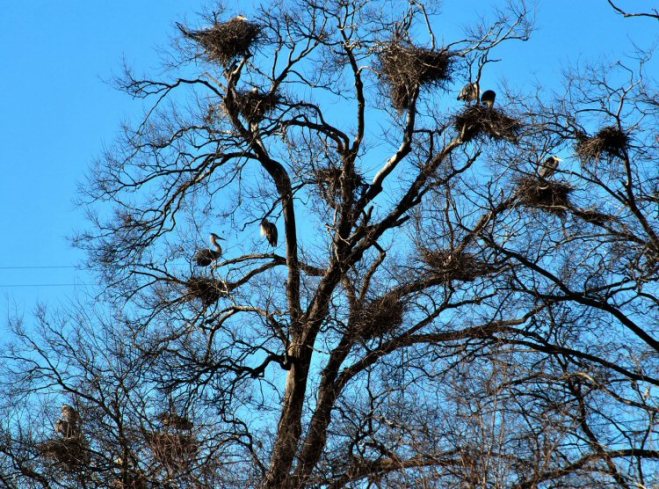
Great Blue Heron Rookery
- Cool Facts From Cornell
- Despite their impressive size, Great Blue Herons weigh only 5 to 6 pounds thanks in part to their hollow bones—a feature all birds share.
- Great Blue Herons in the northeastern U.S. and southern Canada have benefited from the recovery of beaver populations, which have created a patchwork of swamps and meadows well-suited to foraging and nesting.
- Along the Pacific coast, it’s not unusual to see a Great Blue Heron poised atop a floating bed of kelp waiting for a meal to swim by.
- The white form of the Great Blue Heron, known as the “great white heron,” is found nearly exclusively in shallow marine waters along the coast of very southern Florida, the Yucatan Peninsula, and in the Caribbean. Where the dark and white forms overlap in Florida, intermediate birds known as “Wurdemann’s herons” can be found. They have the body of a Great Blue Heron, but the white head and neck of the great white heron.
- Great Blue Herons have specialized feathers on their chest that continually grow and fray. The herons comb this “powder down” with a fringed claw on their middle toes, using the down like a washcloth to remove fish slime and other oils from their feathers as they preen. Applying the powder to their underparts protects their feathers against the slime and oils of swamps.
- Great Blue Herons can hunt day and night thanks to a high percentage of rod-type photoreceptors in their eyes that improve their night vision.
- Great Blue Herons congregate at fish hatcheries, creating potential problems for the fish farmers. A study found that herons ate mostly diseased fish that would have died shortly anyway. Sick fish spent more time near the surface of the water where they were more vulnerable to the herons.
- The oldest recorded Great Blue Heron was found in Texas when it was at least 24 years, 6 months old.
- Thanks to specially shaped neck vertebrae, Great Blue Herons can quickly strike prey at a distance.
- *****
Pick up your fishing Gear please….Wild animals come into contact with fishing line, hooks, and netting in a variety of ways. Waterfowl and turtles become entangled when swimming in bodies of water where line and netting is carelessly discarded. Birds sometimes use fishing line and netting fragments as nesting material, which can lead to entanglement of both the parents and chicks. The ingestion of fishing hooks is most common among turtle species who see the fisherman’s bait as a quick and easy meal. Hooks left in released fish can also be ingested by predators such as birds or large turtles.
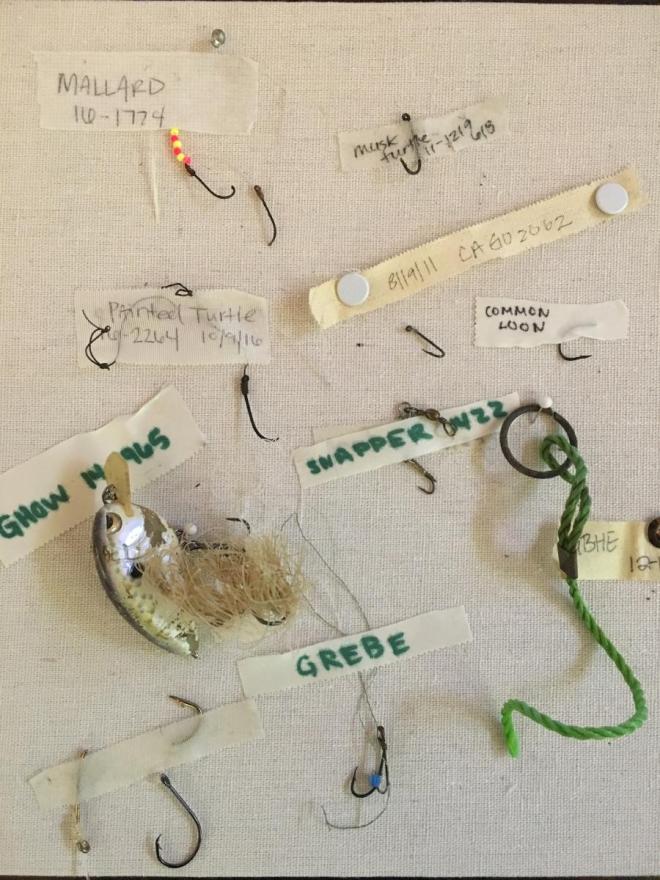
Example of fishing line, hooks etc removed from wild animals not including sea turtles
*****

What are you seeing in nature? It can be from your own backyard, the local park, out on a hike or anywhere. What plants and animals catch your interest? What do you find interesting in nature? Take a photo, write a post, a story, a poem, anything goes because I love to see what Mother Nature is up to in your area. PS..please check back and visit bloggers who post later in the week!
Have a wonderful week from Michelle
 ramblingwoods.com
Is it not delightful to watch birds! I recently sighted a purple heron from my balcony and I was like wow, wow, wow! Perks of lockdown. Nature is thriving and we are getting beautiful sightings 🙂
I have seen news reports of nature moving in a the humans had to retreat in parts of the world…I will have to look up a purple heron..
True that. Nature heals while humans have been kept away. I hope we learn our lessons well
As I sit in the yard and watch the geese and goslings now I wonder…we humans are being paid back for all the horrible things we do to animals and wildlife in particular….
Absolutely. Sometimes I think, minus virus & unfortunate situation, lockdown should be there across the globe once in a while as per schedule. Nature should be given space to breathe…..
Yes, I agree…but it will never happen. Humans are a self-centered species…
so glad you are back, nature is truly our comfort place during these tumultuous days…
Yes and meditation and prayer Lin…
We had grosbeaks here a couple of weeks ago, but they seemed to have moved on, although I did spot 2 of them yesterday! Once the heat hits here, they WILL be gone!
Cheryl..I had a rose-breasted grosbeak pair nest here once and watching them feed the fledgling was so cute..
The mighty blue heron is such a beautiful bird to observe. I did not know that they make a rookery–very clever of them. I wished I lived closer to a body of water to see them more often.
That was a surprise to me too Pat…What a racket all those nestlings must make in a season
Hi,
Love all the photos and information….we a couple that come to the city park once in a while. They are beautiful birds…thanks for sharing. Have a great day!
Thank you for linking in and leaving a comment Sherrie…I so enjoy watching the birds here..
Blue herons are one of my favourites!
I love the green herons too but I don’t see them as often as the blue Karen..
First of all thank you for rescuing that GBH! I had no idea they weighed so little … I’ve actually visited a rookery (years ago, pre-digital, pre-blog) and we marveled at how these huge birds could balance on thin branches….I suppose it should have been obvious that they were light for their size. And just a few years ago I did get some pictures of one GBH nest where a mother was feeding her baby that was almost as big as she was…that was in Fort Lauderdale, it could have been the Florida nest you show! …. thank you, as always, for your research and for sharing it so beautifully. It is appreciated! And for hosting.
It was shocking my husband said as to how light the heron was when he wrapped it in a sheet…waterfowl too, not very heavy Sallie
Yep, definitely dinosaurs! 🙂 And how sad that people don’t pick up their stuff and animals get hurt. I saw an owl the other day and it was amazing.
I would love to see an owl Ramona..I hear great horned owls here and once a barred owl, but I have never seen one..
Those nests are quite interesting!
Yes Lydia and after a while, they must get heavy too
Your great blue herons are even more impressive than our grey herons! We have a grey heron rookery in Edinburgh, it’s always wonderful to watch them in their nests from the hill above their lake. We won’t get to see them for a while though as they’re too far away for us to be allowed to walk at the moment.
Juliet
http://craftygreenpoet.blogspot.com
Juliet…what it takes off it gives this “arkkk” sound that you would expect to hear in a dinosaur movie. They are cranky and shy birds..
Hello, Michelle, good to see you back and posting lovely photos again!
It feels so good to be back Nik.
How wonderful to see and photograph a rookery. I have only seen one once, and we were driving on the highway so no chance to stop for a photo.
Linda..I forgot to label that it is a Nest Watch photo….