
Join Nature Notes Tuesday at 12:00 am EST to Friday at 11:00 pm EST. More information can be found at the top of the blog on a separate page, but it really is easy. What are you or have you seen and enjoyed in nature? It can be from your own backyard, the local park, out on a hike or anywhere. What plants and animals catch your interest? Do you garden? Have you read a good book on nature?
Write a blog post with a photo, a story, a poem, anything goes because I love to see what Mother Nature is up to in your area. Please submit one blog post per week and link back to nature notes in some way.

| 1. | Sallie (Full Time- Life) | 5. | orchid( Japan) | 9. | Mitzi Rice – Barefoot Wanderings |
| 2. | Pictografio | 6. | Pat from Mille Fiori Favoriti | 10. | DAWN |
| 3. | Adam Jones | 7. | D for DAREBIN | ||
| 4. | Day One |
We had a long tough week last week as much of the country did because of the polar vortex which is arctic cold air that dipped into the mid-west and northeast. This blue shows the cold air spreading downwards to us.
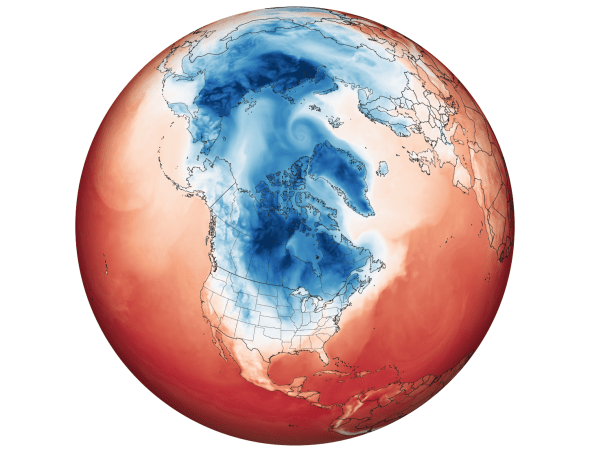
The vortex, is a large area of low pressure located about 60,000 feet up on the atmosphere over both the poles. That’s the polar part. The vortex part describes the counter-clockwise flow of air that keeps the cold polar air up at the poles. Sometimes, however, that flow of air is disrupted, either by the winds changing direction or stopping entirely. Either of these events allows the vortex area to warm, and the cold polar air goes south, causing frigid conditions in much of North America, Europe and Asia.
The other part of the story is “Lake Effect Snow”. We get most of our snow because of the Great Lakes and until Lake Erie freezes over the cold air passing over the warmer lake air causes snow bands to set up and they can drop a lot of snow in a short period of time

The National Weather Service says lake-effect snow accounts for 30 to 50 percent of the annual snowfall on the eastern and southern shores of the Great Lakes, a region famous for the large amounts of snow that falls on it.
This snow falls from bands of clouds that average roughly 10 miles wide and maybe 300 or more miles long. Amounts of snow vary across a region, with the most snow usually falling on hills inland from the lakes.
Thanks to lake-effect snow, cities on or close to the Great Lakes such as Syracuse, Rochester and Buffalo in New York, plus Erie, Pa.; Cleveland; Grand Rapids, Mich.; and Duluth, Minn., are among the snowiest large U.S. cities.
This week, the Weather Service hoisted blizzard warnings for parts of western New York because of an onslaught of lake-effect snow and high winds. The lake-effect snow bands dispensed as much as 19 inches (48.26 cm) in Buffalo where winds gusted over 40 mph creating whiteout conditions. As temperatures plunged to zero and wind chills below minus-30, the Weather Service described a “particularly dangerous situation.”
The map below shows blue bands of Lake Effect snow that dropped a lot of snow in the back yard and shut everything down in area where we are used to snow.

Lake Effect Snow Bands in blue
All of my photos are window shots as it was too cold to be out with the camera and at times we couldn’t see the yard through the blowing snow. My husband uses a shovel not a snow blower and this took hours every day

There were people in trouble who ignored the travel bans and got into accidents and there was probably a lot wildlife that could not survive the night temperatures. I did my best to go out every hour and clean the snow off the feeders and unplug the feeder ports. It was horrible.

goldfinch using heated birdbath
The Weather Service says that about half of the annual average of 90 inches (227 cm) of snow that falls on places along or near the southern and eastern shores of the Lake each year is lake-effect snow.

american goldfinch at feeders
Some really hungry mallard ducks came in and landed on a snowy pond in snow up to their heads to get some food and water. Many ducks stay in this area as parts of the Niagara River leading to Niagara Falls does not freeze and parts of Lake Ontario are open. In bad years many over wintering diving ducks die when they can’t get to fish when the water is frozen
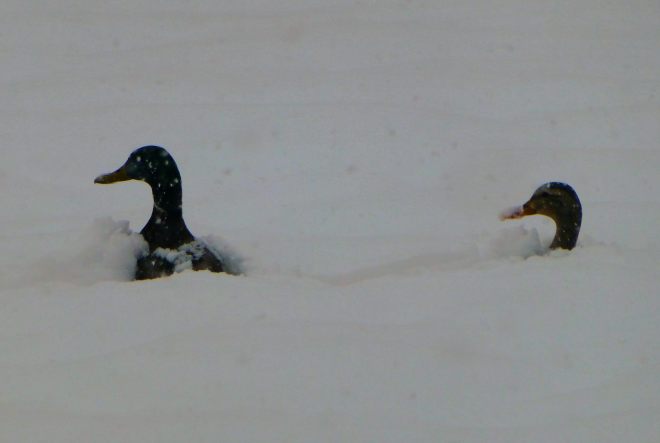
mallard ducks on pond

mallard ducks getting some much appreciated food

Snow…Snow…Snow..and a Blue Jay
This is a video clip shot by a weather chaser in our area. You can hear the blizzard winds howling.
Stay Warm!!

Nature walks are wonderful. But you don’t have to travel to special location to enjoy Mother Nature. There is so much to see in your own neighborhood or even in your own back or front yard. Get a guide-book of the wildlife in your area and learn the calls of birds and frogs and toads. So many times I hear a bird that lets me know what I am looking for in the trees.
 ramblingwoods.com
Oh my word Michelle….those poor birds. Poor you. It’s one thing to see about the vortex on the news but a whole other to see it through a friend’s eyes. (I didn’t see anything at all about the poor birds and wildlife on the coverage I watched….the ones near you were more fortunate than most I m sure, since you kept the feeders operating somehow…I can’t imagine how hard it must be going out there in that weather. … I hope it’s over for the year.
brr…so glad I live in the west. hang in there.
Poor animals 😦
We watched with amazement these extreme weather conditions in North America, Michelle, while we quietly fried here Downunder in temperatures over 40˚C and many bushfires… We have certainly managed to ruin our ecosystem with our thoughtless activities. One hopes that we haven’t gone beyond the point of no return…
PS: Thanks for hosting.
Michelle – when we moved from Cleveland to Montana, people asked us if we would be ready for Montana’s winter. We explained at the time that our part of Cleveland receives as much snow (or more) than many parts of Montana, so no big deal. This has proven to be true so far! Glad you are safe and taking such care of the animals in your backyard!
What a nightmare these days must have been for you and all the residents! Our ecosystem has been so much interfered with that sudden changes in weather take place all the time.